Livingston County Partners Help Shape the Future of Great Start and Help Me Grow
Great Start Collaborative • September 2, 2026
A Community That Picks Up the String
Livingston County partners came together to reflect on an extraordinary year, celebrate the growth of Help Me Grow Livingston, and begin shaping the next chapter of our work supporting families with young children.
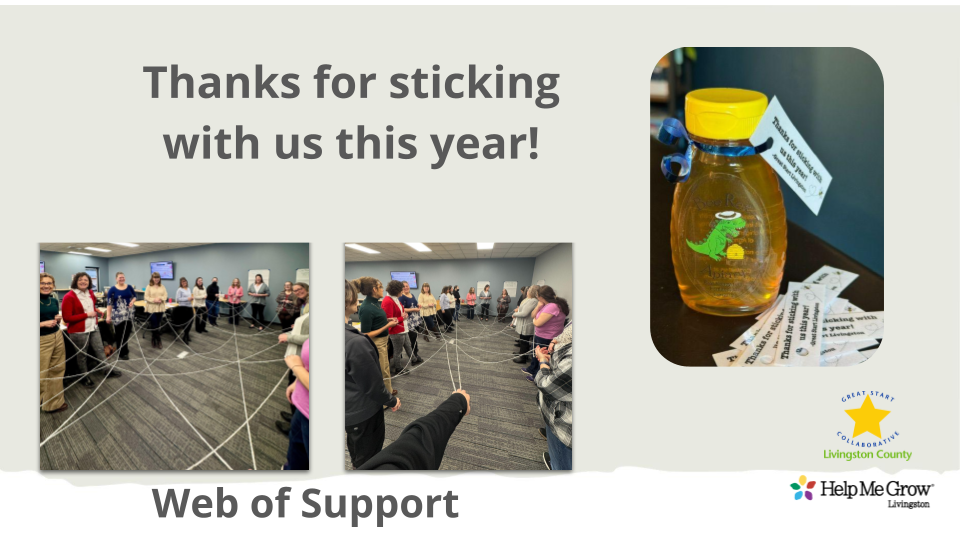
Earlier this year, Great Start Collaborative partners stood in a circle, each holding part of a web made from yarn. The activity was meant to illustrate something we talk about often: no one organization supports Livingston County families alone.
Then we asked a question:
What happens if someone drops their piece of the web?
One partner answered simply: “I’d pick it up.”
None of us knew quite how meaningful that answer would become.
A Year of Community Support
Great Start Livingston entered the past year facing significant uncertainty about the future of traditional funding.
But the work didn’t stop.
Community organizations, libraries, funders, volunteers, and partners continued showing up for Livingston County families. Together, we continued family playdates, developmental outreach, StoryWalks, literacy activities, community events, and connections to resources.
During our September meeting, a partner who works across multiple communities reflected that not every community was able to sustain its collaborative during this period of transition.
Livingston County did.
When we needed someone to pick up the string, this community did.
We are incredibly grateful for the people and organizations who kept sharing resources, opening doors, offering ideas, supporting families, and finding ways to keep this work moving.
Connection Before Content
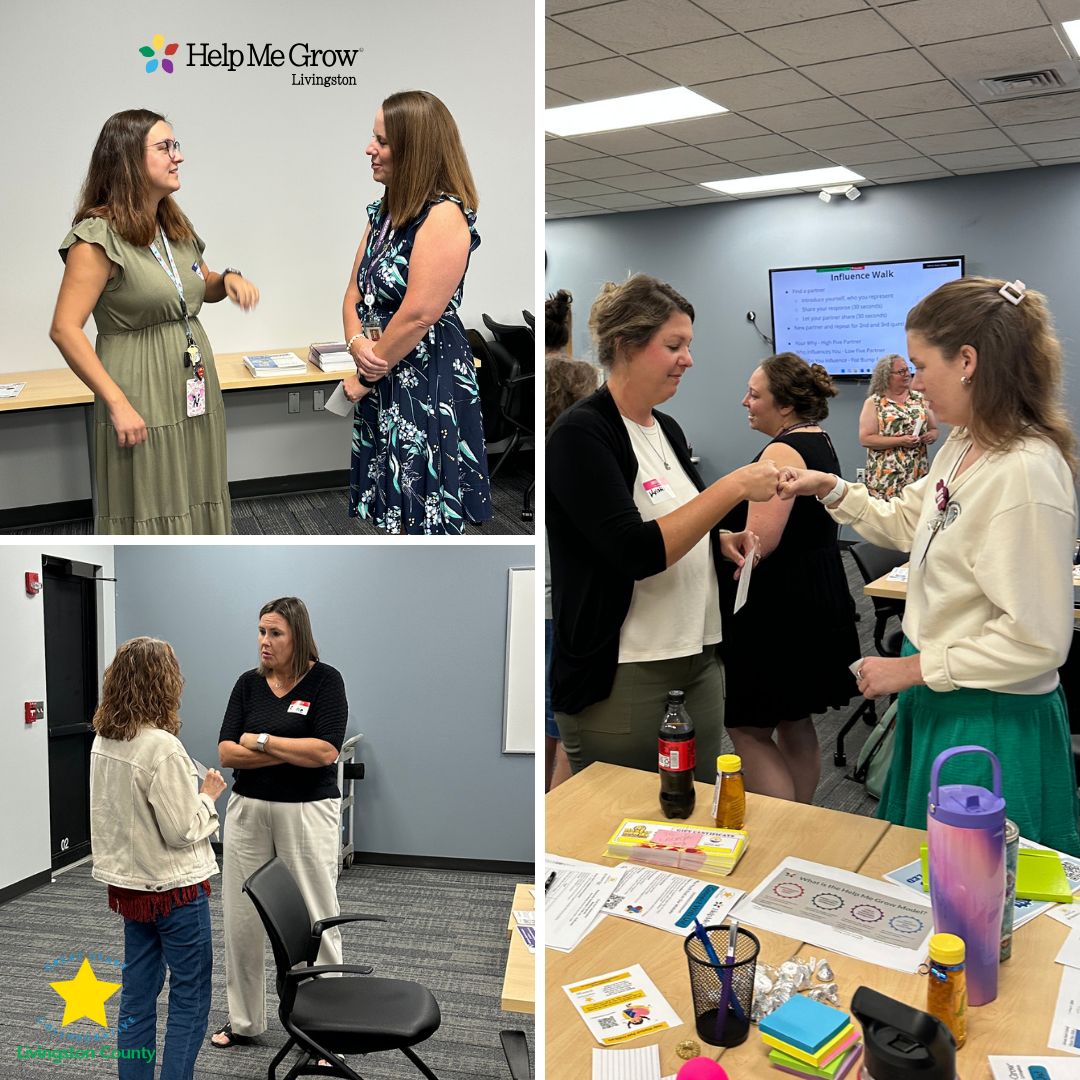
We began our September meeting by returning to the idea that the strength of a Collaborative comes from the people, experiences, relationships, and perspectives represented in the room.
Partners used an index card to reflect on three questions and then moved around the room to share their answers with one another:
YOUR WHY:
What core value or passion drives your commitment to this community collaborative work?
WHO INFLUENCES YOU:
Whose voices, mentorship, or perspective do you seek out before making decisions?
WHO DO YOU INFLUENCE:
Who looks to you for guidance or partnership in this work? Whose voice can you lift up?
Every person in the room brings relationships, experiences, and influence. Those connections are what make a Collaborative work.
Help Me Grow Livingston Is Growing
Help Me Grow Livingston helps families with young children connect to developmental information, screenings, community resources, and supports. It also gives our community a framework for strengthening the connections between families, community organizations, early childhood programs, and health care providers.
Our 2025 Help Me Grow Livingston Impact Report gives us a snapshot of what those connections looked like during the year:
During 2025, Help Me Grow Livingston also recorded 676 contacts with families, 1,166 families reached through outreach, 95 referrals, 103 partner connections, and 125 trainings completed.
This year from January 1 – September 1, 2026 we have had 471 inquiries so far!
Behind each of those numbers is a family asking a question, looking for information, wondering about their child’s development, or trying to find the right resource and a community working together to help make that next step a little easier.
Designing the Next Chapter Together
The centerpiece of our September meeting wasn’t a presentation. It was a conversation.
Help Me Grow gives us a framework for the work ahead, but the knowledge, relationships, experiences, and ideas in this community help determine how that framework comes to life in Livingston County.
Partners reviewed the draft FY27 Great Start Livingston/Help Me Grow work plan and talked together about what we should keep, strengthen, add, and connect.
How can families find the right support without having to know where to start?
How do we make sure families know support exists and trust the pathways to it?
How can health providers become stronger partners in connecting families early?
What can local data and family experiences teach us about gaps, barriers, and opportunities to improve?
What We Heard
The conversation generated thoughtful ideas and important questions about the system we are building together.
Family voice: How do we make sure families’ experiences continue to shape the system as our work evolves?
No wrong door: How can families enter through different trusted organizations and still find their way to the right support?
Help Me Grow and 211: How can these systems complement one another and make referrals easier for families and partners?
Partner knowledge: How do we make sure community partners understand Help Me Grow well enough to confidently connect families?
Health care connections: How can pediatricians and other health providers become stronger pathways to developmental and community supports?
Family experience: Where can we reduce barriers and make developmental screening and resource navigation easier?
Data and learning: What information should we collect, how do we protect families’ privacy, and how can we use what we learn to identify gaps and improve the system?
How will we know we’re making the early childhood system easier for families to navigate, not simply doing more activities?
Those questions won’t be answered in one meeting, and we don’t expect them to be.
That’s the value of continuing to learn and work together.
Families Must Help Shape the System
One idea was especially important throughout the conversation: we cannot build a system for families without intentionally listening to families’ experiences using it.
Family voice has long been an important part of Great Start Livingston. As our work increasingly aligns with the Help Me Grow framework, we want to continue creating meaningful opportunities for parents and caregivers to tell us what’s working, what’s difficult, what’s missing, and what would make getting support easier.
Success isn’t simply holding more events or making more referrals.
We want families to experience a community that is genuinely easier to navigate.
We want fewer families to say,
“I wish I would have known about that.”
Looking Back on Summer
One of the clearest examples of what partnership made possible was our summer work with families.
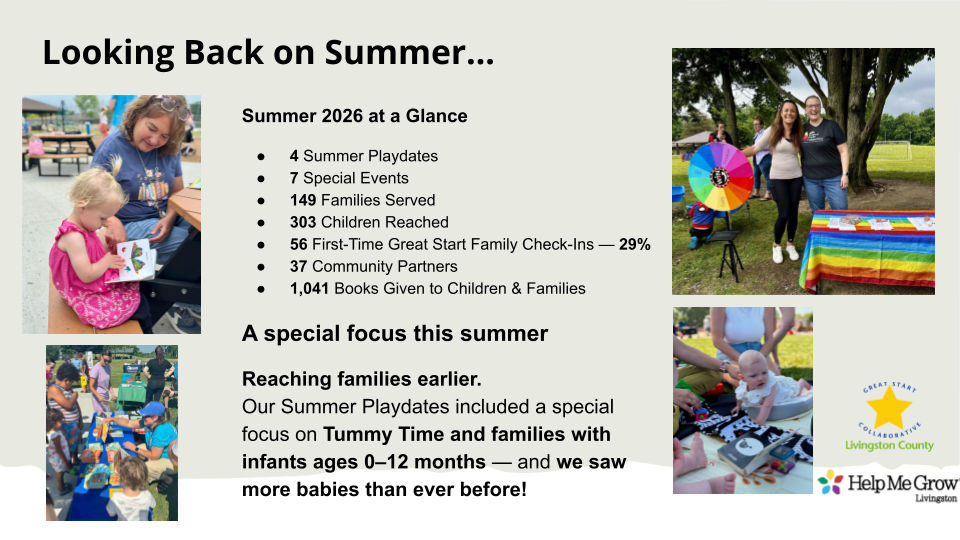
This summer, we intentionally focused on reaching families earlier. After listening to Early On providers, our playdates included dedicated spaces and activities for babies ages 0–12 months, with a special focus on tummy time, developmental milestones, and connection for new parents.
And we saw more babies than ever before.
It was a simple but powerful example of what can happen when partners share what they are seeing, we listen, and together we adjust how we reach families.
What Comes Next
The FY27 work plan is still a draft. Feedback from Collaborative members will help shape the next version as we continue receiving guidance and developing the work ahead.
We’ll take what partners shared, look for themes, connect those ideas with the requirements and opportunities ahead, and continue the conversation together.
Carrying the Conversation Forward
Today’s discussion was a starting point, not the finish line. We’ll use what partners shared to strengthen the draft, continue learning from families and community partners, and keep building a plan that makes sense for Livingston County.
Our purpose remains clear.
Connect Livingston County families with young children to the people, information, developmental supports, and resources they need. Continue building a community where families don’t have to figure it all out alone.
For Livingston County Families
Get Connected to Help Me Grow Livingston
Have a question about your child’s development? Looking for a local program, parenting support, preschool information, developmental screening, or another resource for your family?
You don’t have to know which program to call first. Help Me Grow Livingston is here to listen, help you sort through your options, and connect you with resources and supports that fit your family’s needs.
Families can also connect with Help Me Grow for developmental screening using the ASQ-3 and ASQ:SE-2. These screenings can help parents and caregivers learn more about how their child is growing, learning, communicating, moving, and interacting with others.
Not sure whether Help Me Grow is the right place to start?
That’s okay. Reach out anyway. Helping families find the right next step is exactly what Help Me Grow is designed to do.