
Why Tummy Time Matters: Easy Tips for Your Baby’s First Year
MEET OUR GUEST CONTRIBUTOR

Cristian LaBar
MOT, OTR/L, C/NDT, CLC
Early On Coordinator
Livingston Educational Service Agency

What is Tummy Time?
Tummy time is when your baby lies on their belly while they are awake and you are watching them. Even a few minutes a day helps your baby grow strong.
Why Is Tummy Time Good for Babies?
Babies sleep on their backs to stay safe. When they are awake, tummy time helps them use new muscles. Tummy time:
- Makes their head, neck, and shoulders strong.
- Helps them learn to roll, sit, crawl, and walk.
- Keeps the back of their head nice and round by stopping flat spots.
- Helps them reach, play, and look around.
When to Start and How Long to Do It
You can start tummy time right after your baby is born, as long as your doctor says it is okay. Start with just 2 to 3 minutes a few times each day. As your baby gets stronger, you can add more time.
Here is how much total tummy time to aim for each day:
| Baby's Age | Total Time Each Day |
|---|---|
| By 2 Months | 15 to 30 minutes |
| By 4 Months | 45 minutes |
| After 4 Months | 90 minutes |
Best times to do it: Try tummy time when your baby is calm and wide awake. Great times are right after a nap, after a bath, during diaper changes, or while you read and play together. Short sessions all through the day work best.
Easy Ways to Make Tummy Time Fun
Some babies do not like tummy time at first. That is okay! Try these easy tricks to help your baby enjoy it:
- Get down on the floor: Babies love looking at your face. Lie down with them, smile, sing, and talk.
- Use fun toys: Put bright toys, baby mirrors, or toys that make noise in front of your baby. Put toys in a circle so they look both ways and reach out.
- Try new ways to hold them: Tummy time does not just happen on the floor. Lay your baby on your chest while you lean back, put them across your lap, carry them like an "airplane," or lay them on their side.
- Give a little help: Roll up a small towel and put it under your baby’s chest. Keep their arms in front of the towel and make sure their chin is clear.
- Take breaks from baby seats: Try not to leave your baby in swings, bouncers, or car seats for too long when you are not driving. Hold and play with them in different positions instead.
Stay Safe and Watch Your Baby
Always follow this rule:
Back to sleep, tummy to play.
Always watch your baby during tummy time, use a firm and safe spot, and only do it when your baby is awake.
Watch your baby to see when they need a break. Stop tummy time if your baby starts crying or fussing, puts their face down on the floor, or gets too tired to hold their head up. Stopping early keeps tummy time happy and fun.
When to Ask for Help
Every baby grows at their own speed. Talk to your baby’s doctor or a therapist if you see any of these signs:
- Your baby only turns their head one way.
- Your baby has a hard time lifting their head.
- Your baby always hates tummy time.
- One side of your baby’s head looks flat.
Remember, just a few playful minutes at a time really add up. Every minute helps your baby grow stronger—you are doing a great job!
LOCAL OPPORTUNITIES & RESOURCES FOR FAMILIES
WELCOME BABY
Expecting a Baby or Have a Baby Under One?
We are excited to welcome our littlest Livingston County residents!
Free Welcome Baby Bags are available for all expectant families and families with babies up to 12 months old.
Our Welcome Baby Bags help celebrate your baby's arrival and connect your family with early literacy materials, developmental information, and local resources.
Connect with us at one of our winter playdates or visit our Welcome Baby webpage to learn more and request your bag.
How Is Your Baby Growing and Developing?
From lifting their head during tummy time to reaching for a favorite toy, smiling, and making sounds, your baby is learning new skills every day.
As a parent or caregiver, you know your child best. A free developmental screening can help you learn more about your child's growing skills, celebrate their strengths, and discover ways to support their continued development.

What Is the ASQ?
ASQ stands for Ages & Stages Questionnaires. These age-specific questionnaires are completed by parents and caregivers based on what they observe during everyday routines and play.
Think of the ASQ as a developmental check-in. It is not a test or a diagnosis. It is an opportunity to better understand your child's development.
- Free: There is no cost to families.
- Quick: Each questionnaire takes approximately 10–15 minutes.
- Parent-centered: Your observations and knowledge matter.
- Supportive: Receive feedback, activity ideas, and resource connections.
Why Complete a Developmental Screening?
Developmental screening is helpful for all children, including children who appear to be developing as expected. Screening can help you understand what to look for next, guide conversations with your child's healthcare provider, and identify when additional support may be helpful.
Two Screeners. One Whole Child.
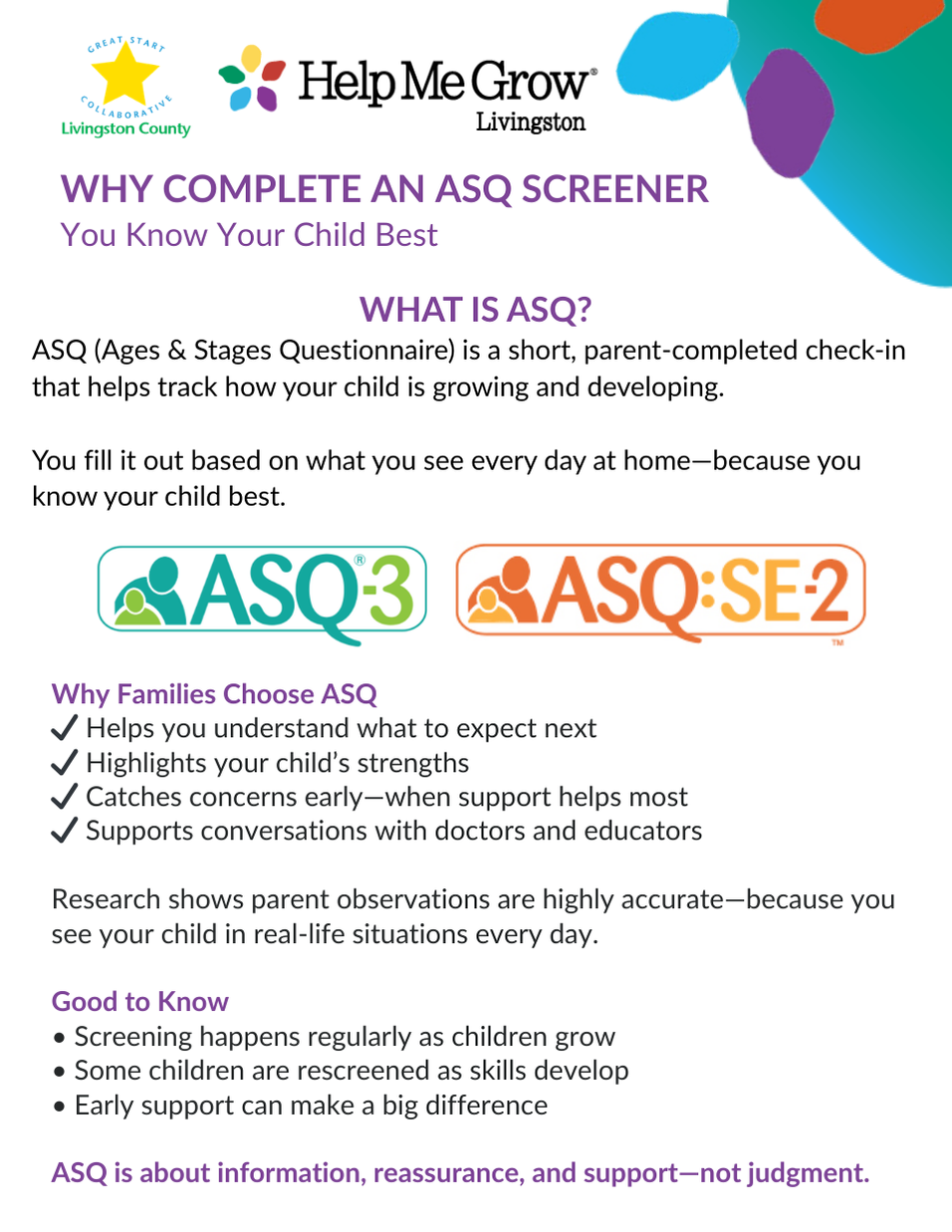
Help Me Grow offers two types of Ages & Stages Questionnaires to help families understand different areas of their child's development.

Developmental Skills
The ASQ-3 explores five areas of development:
- Communication
- Gross motor skills
- Fine motor skills
- Problem-solving
- Personal-social skills
Movement skills, such as lifting the head, reaching, and rolling, are among the skills you may explore on your baby's age-appropriate questionnaire.

Social-Emotional Development
The ASQ:SE-2 explores how your child is developing socially and emotionally, including:
- Expressing emotions
- Calming and settling
- Responding to caregivers
- Interacting with others
- Adjusting to daily routines
How Do I Complete a Free ASQ?
1. Complete Your Screening
Answer questions about your child's everyday skills using an age-appropriate ASQ questionnaire.
2. Talk With Your Care Coordinator
After you submit your screening, our Help Me Grow Livingston Care Coordinator will contact you with your child's results within 3–5 business days.
3. Celebrate, Learn, and Connect
Learn about your child's strengths, receive activity ideas to try at home, and connect with additional resources or services if helpful.
 Start Your Free ASQ Screening
Have questions or need help completing a screening? Call or text 844-464-0005.

More Resources for Livingston County Families
-
Prenatal, Postpartum, Infants & Toddlers
Explore information and resources for your pregnancy, your baby's first year, and beyond. -
Welcome Baby Bags
Learn about our free Welcome Baby Bags for expectant families and families with infants. -
Great Start Livingston Playdates
Find opportunities to play, learn, and connect with other local families. -
What Is the ASQ?
Explore our parent-friendly guide to developmental screening. -
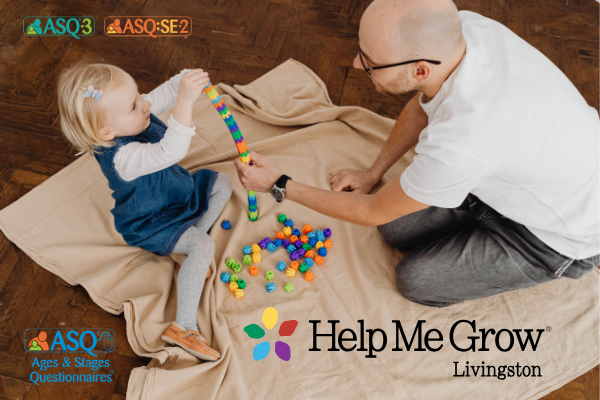
A Parent's Story: How a Developmental Screening Opened the Door to Speech Support
Read how a Livingston County family's questions led to developmental support through local connections. -
Early On Michigan
Learn about early intervention services for infants and toddlers and their families.

Thank you to our community partners!
Thank you to Cristian LaBar and Early On Livingston for contributing this article and partnering with Great Start Livingston and Help Me Grow Livingston to support our youngest learners and their families.
Together, we are helping build a community where families can access trusted information, build meaningful relationships, and connect with the resources and supports they need.
This article provides general educational information and is not a substitute for individualized medical advice. If you have questions or concerns about your child's health or development, speak with your child's healthcare provider.